

Healthcare &
Wellness App Development
Most of the care a person receives does not happen in the appointment. It happens in the weeks between appointments, at home, alone, when the clinician is not there and the instructions have been half-forgotten.
That is the gap these products exist to fill, and it is a harder design and engineering problem than it looks. The software has to serve two completely different users from one system, hold data that cannot leak, and remain usable by someone who is anxious, in pain, or impaired by the exact condition the product is meant to help with.
We build cross-platform apps and the platforms behind them for care providers, clinics and wellness businesses. Patient-facing and practitioner-facing, usually both, usually sharing one backend.
What We Build
Not every product needs all of this. These are the parts we go deep on when one calls for them.
-
Patient apps
The half the person at home uses. A course of treatment to follow, exercises or routines to complete, progress to record, and a way to reach the people treating them. Built so that someone opening it on a bad day can still find the one thing they came for.
-
Practitioner-facing tools
The other half of the same product. A clinician sees a caseload, not a treatment plan: who needs attention, who has stopped engaging, what changed since last time. Different information, different priorities, same underlying data. We have built exactly this split, with patient and practitioner roles over one system.
-
Between-session tracking
Check-ins, symptom and activity logging, guided exercises, adherence records. The engineering question is almost never how to store it. It is how to ask for it often enough to be useful and rarely enough that people keep answering.
-
Roles, access and audit
Who can see which record, who changed what and when, and a trail that answers that question months later. On most products this is a feature. Here it is the foundation, and retrofitting it is expensive.
-
Accounts across more than one product
A single login working across separate apps on one shared backend, where a care product and a wellness product serve overlapping audiences. We have built this: one product line, two apps in the stores, one account.
-
Scheduling and reminders
Appointments, courses with a defined duration, notifications that arrive at a useful moment. See [LINK: booking and scheduling platforms | /industries/booking-scheduling-platforms/] for products where this is the whole business rather than a component.
-
The backend underneath
Data model, access control, integrations and the reporting layer. Most of the risk in a healthcare product lives here rather than in the interface. See backend and API development.

What is
Different About
Building Here
Four things that are not true of most software and are true of all of this.
-
Two users, one system, almost nothing shared
A patient and a practitioner want opposite things from the same data. The patient wants today, simply. The clinician wants the pattern across forty people. Treating this as one product with a permissions flag produces something that serves neither, and it is the most common structural mistake we are asked to fix.
-
The person using it is not at their best
This is where accessibility stops being a compliance line and becomes the product. Your user may be elderly, may have the visual impairment the app is treating, may be using one hand, may be reading it at three in the morning. We design and test against WCAG 2.1 AA as a scoped, costed part of the work — contrast, target sizing, dynamic type, screen reader paths and navigation order — because on this kind of product it decides whether the thing gets used at all.
-
Tone is part of the treatment
An interface that is brisk about a missed day, or cheerful about a bad result, undoes work the clinician did in the room. Copy, timing and the handling of failure states carry clinical weight here in a way they do not in a retail app, and they belong in the design rather than being written at the end by whoever is available.
-
The data has consequences
Encryption in transit and at rest, access scoped to role, an audit trail that is actually queryable, defined retention and deletion, and a clear answer to where the data physically lives. We build to the requirements your compliance team or counsel sets, and we scope that work explicitly rather than assuming it.
Do You Have a Project Idea?
Tell us what you want to build. We come back with a rough estimate and an honest view of what it takes, before anyone signs anything.
Selected Work
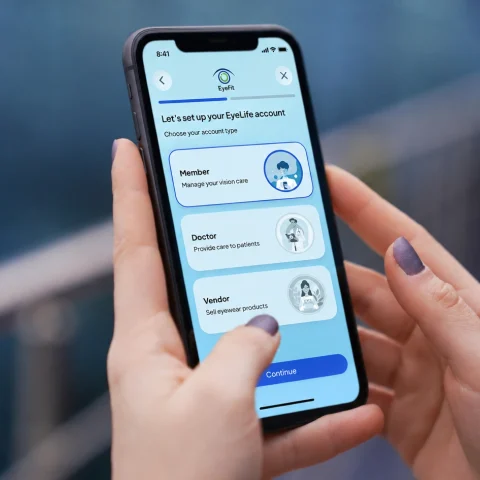
- Vision Care Patient Platform. Patient app for managing a course of eye care, with separate patient and practitioner views of the same record. Later extended into a second wellness app sharing the backend and the same accounts.
- Therapist and Client Engagement App. Cross-platform mental health product connecting therapists with their clients, with guided exercises and between-session tracking. A product where the tone of the interface is part of the clinical experience.
What We
Bring To it
An industry is not a service. These are the services this work is usually made of.
- Mobile App Development — cross-platform apps in React Native, shipped to both stores
- Mobile App Design — including the states a person meets on a bad day
- Backend and API Development — roles, access control and the audit trail
- Web App Development — the practitioner-facing half, where it belongs in a browser
- Application Support — because a product people depend on cannot go unmaintained

How We
Work Together
-
Fixed scope
A defined build, priced per module, with a timeline. Suits a clear brief. -
Ongoing team
Developers, QA and design working to your roadmap. Suits products that will keep changing as the service around them does. -
Support retainer
Every project includes one month of bug fixing after launch at no extra cost. After that, ongoing work runs as a support retainer with agreed response times.A typical first version runs with two developers, a QA engineer and a designer. Larger platforms scale from there.We price every project individually. There are no packages, because the work does not arrive in packages.
Questions We
Get Asked
-
We build to the requirements your compliance team or legal counsel defines — encryption, role-scoped access, audit logging, retention and deletion rules, and data residency. What we do not do is tell you what those requirements are. Regulation varies by jurisdiction and by what the product actually does, and that determination belongs with people qualified to make it. Bring us the requirements and we will scope the engineering against them and show you where it lands in the estimate.
-
We build cross-platform, in React Native. One codebase for both stores, one team maintaining it, and both versions behaving the same way. For most products in this space that is the right answer and a cheaper one. If yours depends on something only a native build can do, we will tell you during scoping rather than after you have signed.
-
Usually. Practice management systems, scheduling platforms and record systems vary enormously in how reachable they are, and some are considerably harder than their documentation suggests. We scope integration work separately for that reason, and we will tell you what we find before committing to a timeline rather than discovering it halfway through.
-
As scoped work with hours against it, not as a final pass. WCAG 2.1 AA is a line in our estimates. On this kind of product it is also a commercial question, because a patient who cannot use the app is a patient who goes back to phoning the clinic.
-
Yes, starting with an audit. Inherited healthcare products need the access and audit layer checked first, because that is where a quiet problem becomes a serious one. See project takeover and modernisation.
-
We give you a rough estimate as soon as we understand what the product has to do. The detailed number comes after the scope is agreed, broken into modules and priced individually, so you can see what the practitioner side, the audit trail or an integration actually costs and decide what belongs in version one.